Commerce celebrates historic milestone connecting Washington aerospace companies with global opportunities at the Farnborough International Airshow.
By Joanna Boatwright
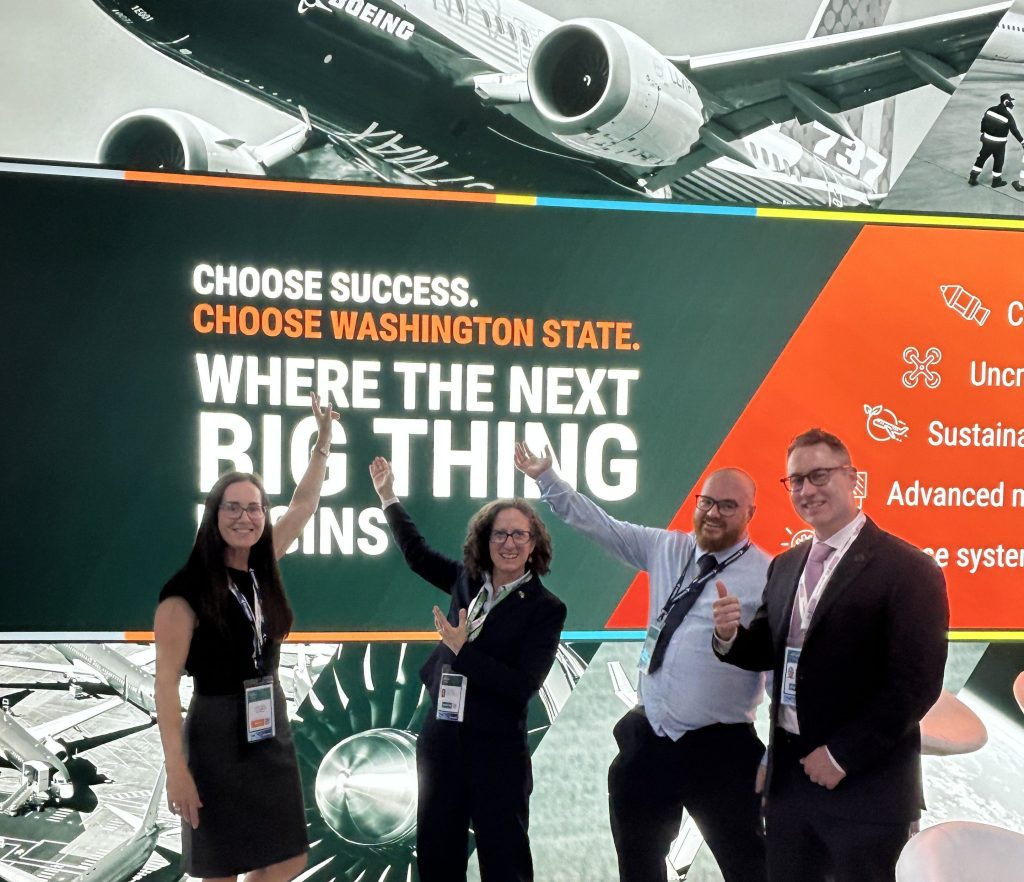
Global aerospace, defense and space industries converge at the Farnborough International Airshow every two years to build connections, pursue opportunities and get business done. For the Washington State Department of Commerce, Farnborough 2026 marked 30 years of bringing Washington aerospace companies to one of the world’s most important industry gatherings. It was also our largest delegation yet: 19 companies and four regional partners joined us at the Washington State Pavilion, ready to stand out.
Bringing Washington to the World
Washington’s pavilion is strategically located in the European exhibition hall, one of only two American pavilions among European exhibitors. This year’s bold Washington branding was difficult to miss, drawing visitors throughout the show. That visibility matters. For a small or medium-sized aerospace company, getting in front of the right international customer can be difficult. At Farnborough, we put Washington companies on loudspeaker. Our delegation represented the breadth of Washington’s aerospace industry, from precision machining, castings and advanced composites to engineering, flight testing, supply chain solutions and spacecraft.
Together with our regional partners, they represented an aerospace ecosystem of more than 1,500 companies spanning commercial aviation, defense, uncrewed aerial systems, sustainable aviation and a rapidly growing space sector. At Farnborough, that ecosystem is on a global stage.
Where Meetings Become Opportunities
While aircraft fly overhead and new technologies fill the exhibition halls, much of Farnborough’s real impact happens around tables. Procurement teams, technical leaders and decision-makers arrive looking for suppliers, innovation and partners. Preparation for those conversations begins months before the show.
Working with our European representatives, Commerce researched prospective customers and partners and conducted targeted outreach. Nearly 100 meetings were secured for delegation members, including meetings with major global aerospace and defense companies. Washington companies also built their own schedules. For example, one arrived with more than 45 meetings already booked at the event.
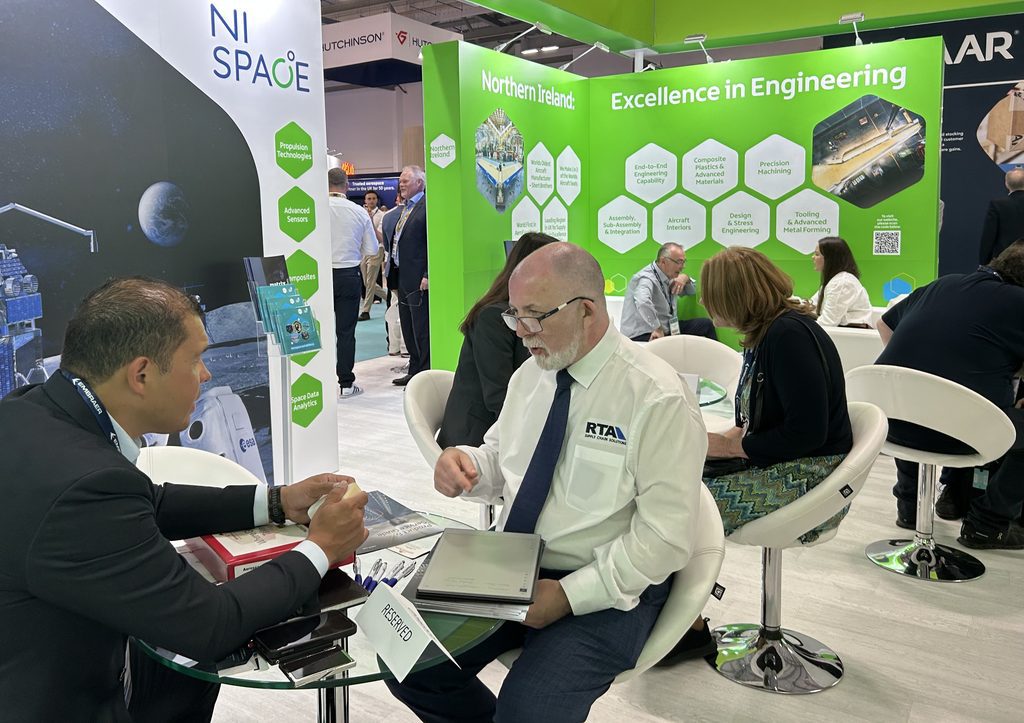
Inside the Washington Pavilion, our two conference rooms turned over nearly every 30 minutes. Meetings happened at our pavilion, on company stands and in corporate chalets. When conversations revealed an opportunity for another Washington company, introductions were made in real time.
That is international trade development on the ground: preparation creating opportunity, opportunity creating conversation and conversation opening a door.
Relationships Are Still the Business of Aerospace
For all the extraordinary technology on display, international trade still comes down to something decidedly human: relationships. A single meeting doesn’t always lead to a new customer. Companies need opportunities to reconnect, continue conversations and build trust. Our longstanding relationship with Northern Ireland resulted in a targeted “speed dating” session between companies from the two regions. Five Washington companies participated and at least one conversation progressed to a nondisclosure agreement.
We also hosted two networking receptions, giving companies another opportunity to connect face-to-face with customers and prospects. These aren’t simply social events. In an industry where relationships can take years to develop, every chance at another conversation matters.
The Work Continues After the Show
An international trade show may provide the introduction, but success comes from what happens before, during and after the event. By the time our delegation left Farnborough, some conversations were already producing results. One Washington company secured a substantial contract with a major customer on-site. Another has since reported productive ongoing discussions with two companies it met during the show. Across the delegation, companies are following up on leads and continuing technical and commercial discussions. For small and medium-sized companies, that work is critical. Commerce helps them prepare for international markets, connect with the right people and turn introductions into long-term business opportunities.
Building the Next Generation of Aerospace
Farnborough 2026 offered a glimpse of where the industry is headed. Defense had an increasingly visible presence this year, alongside continued investment in commercial aviation, advanced manufacturing, sustainable propulsion, advanced materials and space. Washington is well positioned across these markets. Our state is home to nationally-recognized hubs advancing sustainable aviation, hydrogen and advanced composite materials. Companies and researchers are designing more efficient aircraft, developing lighter and stronger materials and creating spacecraft and launch systems.
What distinguishes Washington isn’t simply the breadth of those capabilities. It’s how they connect. Manufacturers, suppliers, researchers, academia, entrepreneurs, airports, airlines, government and regional partners work across industries to solve difficult problems and commercialize new technologies. At Farnborough, we take that collective capability to the world.
Where the Next Big Thing Begins
After 30 years at Farnborough, the scale stands out. In 2026, more than 141,000 visitors representing 136 countries attended. But for Washington companies, Farnborough’s value isn’t measured simply by attendance. It’s measured in the right people finding one another. A procurement leader looking for a new supplier. A Washington manufacturer sitting down with an international customer. An introduction that becomes a second meeting. A conversation that continues after everyone flies home.
For generations, our companies have transformed ambitious ideas into products and technologies that change how the world travels and communicates. Today’s aerospace community is building on that legacy while taking the industry in entirely new directions. Our job is to make sure the world knows where to find them — because the next big thing in aerospace isn’t some distant possibility.
In Washington, we’re already building it!
Ready to Take Your Business Global?
For Washington small businesses interested in pursuing international markets, cost doesn’t have to be a barrier. Commerce’s State Trade Expansion Program (STEP) offers qualifying Washington small businesses export vouchers of up to $10,000 to help offset eligible international business development expenses. Reach out to me at Joanna.boatwright@commerce.wa.gov for more information.
Learn more about the STEP export voucher program.
Learn more about our international trade shows.
Learn more about our monthly seminars on topics related to exporting.