How a Collaborative Oregon Manufacturer is Expanding Its Role in Advanced Industries
By Jennifer Ferrero
Vision Plastics of Wilsonville, Oregon, makes plastic parts ranging from a pinhead to eight pounds. The company operates in a collaborative environment with about 130 employees and focuses on healthcare, including dental chairs. President Brian Stevens said, “This is the best-kept secret in Wilsonville, but half of Wilsonville doesn’t know what we do.” The company holds medical industry certifications and believes those credentials will translate well to the aerospace industry. Currently, only 5% of its business is in aerospace, but it is ready to expand that share.
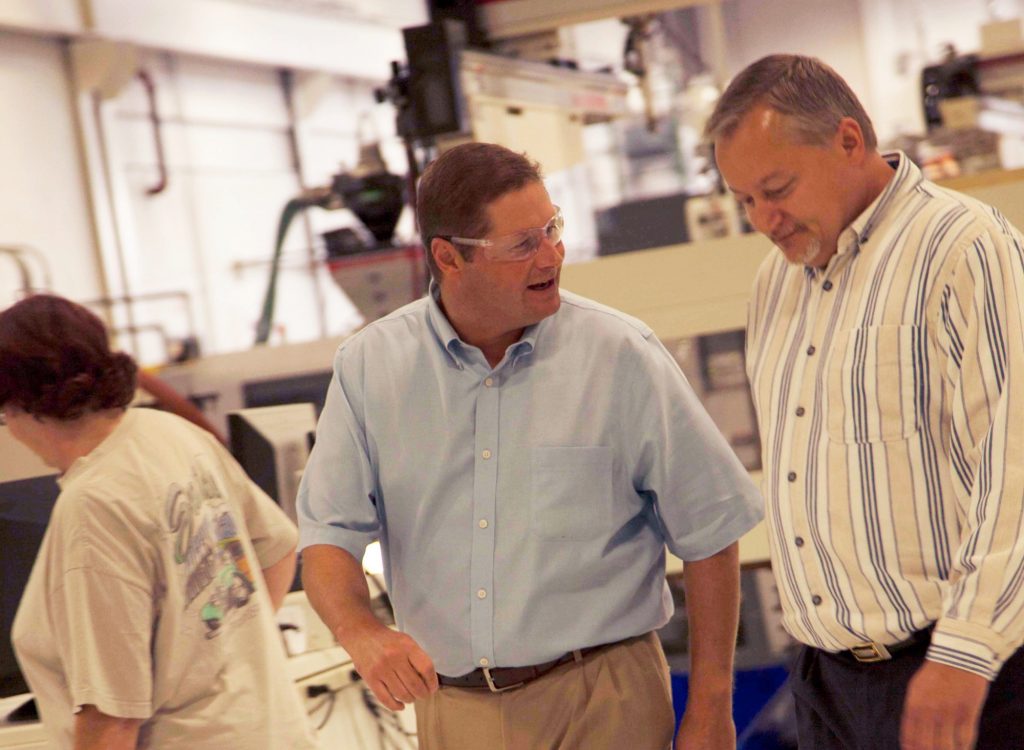
Sales Manager Joe Traverso said the location south of Portland is a prime advantage: “We’re right on the I-5 corridor, so we can ship to the Bay Area and California as easily as we can ship to Seattle; we can ship to the I-90 corridor.” He said that being outside Portland, south toward Salem, gives employees easier commutes with less traffic. He added, “One advantage is that where my employees live creates a great commute — not too far across a big city. I think the location is good for customers and employees, and where we draw employees from.”
A customer — Lightspeed Aviation, a Lake Oswego, Oregon-based aerospace manufacturer — makes noise-cancelling headsets for pilots. Purchasing Manager Madison Ratto has worked with the company for four years on its purchasing needs, including made-to-spec materials from Vision Plastics.
She said, “We purchase plastic components, so my perspective is rooted in the value they consistently deliver to us as a supplier. While the quality of their products is excellent, what truly sets them apart — and why this partnership is so important to us — is their exceptional customer service. In today’s environment, that level of responsiveness, accountability, and care is increasingly rare.”
Brett Ferguson is a business development manager at Vision Plastics and has been with the company for five and a half years, joining during the pandemic. He said that when he started, his role was broad and “a catch-all role,” but over a couple of years, the company did serious work on “getting the right people into the right seats, including managers,” which created the strong, solid company they have today.
Ferguson’s background was interesting because he had experience in Japanese language and math instruction. At one point, he also interned at Boeing in the quality department, bringing those skills into the education realm to help teachers understand how Boeing manages quality assurance. Later, he switched from teaching to working at an injection molding company owned by a Japanese family. He said his Japanese language skills helped him in that job, and the Japanese way of doing things has influenced his work today. He said the Japanese have solid manufacturing frameworks that he picked up during his tenure with that company and were reinforced on his biannual trips to Japan.
At Vision Plastics, Ferguson said they created the Make It Better (MIB) program for all 130 employees. He called it the Vision Plastics 1.0 program at the start: “Vision 1.0 was to do what you are told, Vision 2.0 was to make it better.” Over time, the program became a lynchpin of their culture. They adopted an open-door policy with the CEO and fostered company growth through regular monthly lunch meetings. Employees are encouraged to bring 10 suggestions a month, from simple ideas to earth-shattering changes. Ferguson said they listen, discuss, and implement changes to make the company better for everyone.
From a sales standpoint, both Ferguson and Traverso said these changes have created a solid team they can count on as they grow the business. Traverso added that they’ve developed a great ecosystem with the staff. “I don’t dread going to work every day. The people make it fun. There aren’t many egos in the company. It’s a team environment.” He said they have good customers and personal relationships with them.
Traverso also had an interesting start, where he vowed never to work for a family-owned manufacturing company again. “I am not an engineer; I have a background in economics and math from Willamette University.” He started his career in banking and consumer finance. But he ended up working in metal manufacturing as part of a sales program. They were doing sheet-metal fabrication for Daimler, which he said went out of business in 2013 due to military contracts drying up. He was recruited as a sales manager and has now been with Vision Plastics for eight years. Today, he said, “I really like this type of business, the role, and what we are doing.” He added, “We make other people’s designs as a build-to-print company.”
The business is a $25 million-a-year company, currently focused on healthcare, electronics, information technology, and industrial equipment, with room to grow in injection molding, assembly, engineering, and automation.
According to Traverso, long-term relationships and projects are the name of the game for Vision Plastics. He shared, “We are not a transaction; we are supporting production lines that will last 20-25 years.” He sees that work as a form of sustainability for families in their community.
Ratto echoed their commitment to customers: “Their commitment is not just appreciated — it’s a key reason we continue to rely on them as a trusted partner.” She said Vision Plastics offers next-level value: “They proactively partner with us to evaluate materials, processes, and tooling to identify meaningful cost-saving opportunities while maintaining quality. A recent example is a component we previously had painted — through their guidance, we eliminated that step entirely and reduced the cost by 50%. This kind of insight and collaboration is exactly the value we aim to achieve in our supplier relationships.”
The company has over 45 injection molding machines, according to their website visionplastics.com, and has begun adding cobots to the factory floor. It is also embracing AI and Large Language Models (LLM), Ferguson said: “We are trying to make tedious, manual tasks faster. Any job that is dangerous, dirty, or difficult; we are looking at data. AI is helping me understand my business ecosystem and how to communicate it better.”
As a manufacturer, problem solving for customers is critical. Ferguson shared a story about almost telling the customer their project was a no-go, saying it would have been a mistake. He said they had to understand the needs of both their company and the customers. By understanding the pain points on both sides, they were able to solve a serious problem.
He added, “It is still challenging because they operate in 10s of microns, while we operate in 1000s of an inch; plastic sometimes shrinks; their tolerances are tight.” But he said they did come together to make it work.
The 90,000-square-foot facility also offers in-house electromechanical assembly, sonic welding, heat staking, post-mold machining, and a full range of other post-mold operations.
Additionally, they offer painting, printing, EMI coating, plating, and vacuum metallization.
In summary
Vision Plastics of Wilsonville, Oregon, is a smart, dedicated team established across healthcare, electronics, and other advanced industries — and is now poised to expand its presence in the Pacific Northwest aerospace market. With a focus on innovation, the company is investing in automation, AI, and advanced manufacturing technologies to stay ahead in a competitive landscape.
As Ferguson notes, “For years, we had a turnover rate of 60% — for various reasons; after implementing Make It Better, we are at 20% year to date. While reducing turnover isn’t the only goal, we intend to treat vendors, employees, and customers right.” This commitment to relationships, responsiveness, and continuous improvement sets Vision Plastics apart and paves the way for sustainable growth.
For those seeking a partner dedicated to quality and collaboration or a workplace that values ideas and people, Vision Plastics continues to build on its legacy — proving that the old-school way of doing business can drive modern success.