FROM THE READER: Bob & Diane Dempster from Seattle World Cruiser
By Bob and Diane Dempster
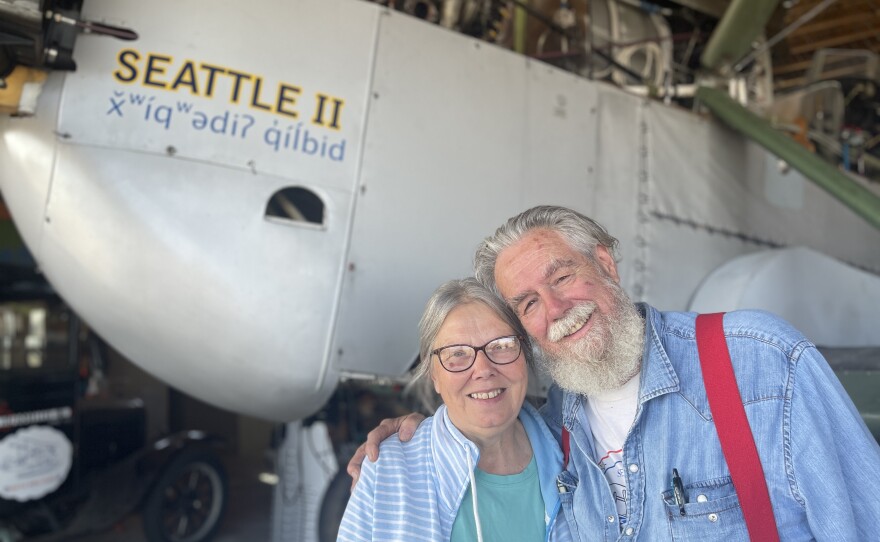
This article is but a blink of the eye describing the wonderful journey of building the Seattle World Cruiser.
THE BEGINNING
“So, Bob, what’s next?”
“I’m going to build a 1924 Douglas World Cruiser.”
That question came from Seattle’s Museum of Flight’s Curator, Dennis Parks (and my answer came from an alien in the back of my head). I had never, for a moment, thought of doing what I just said I’d do.
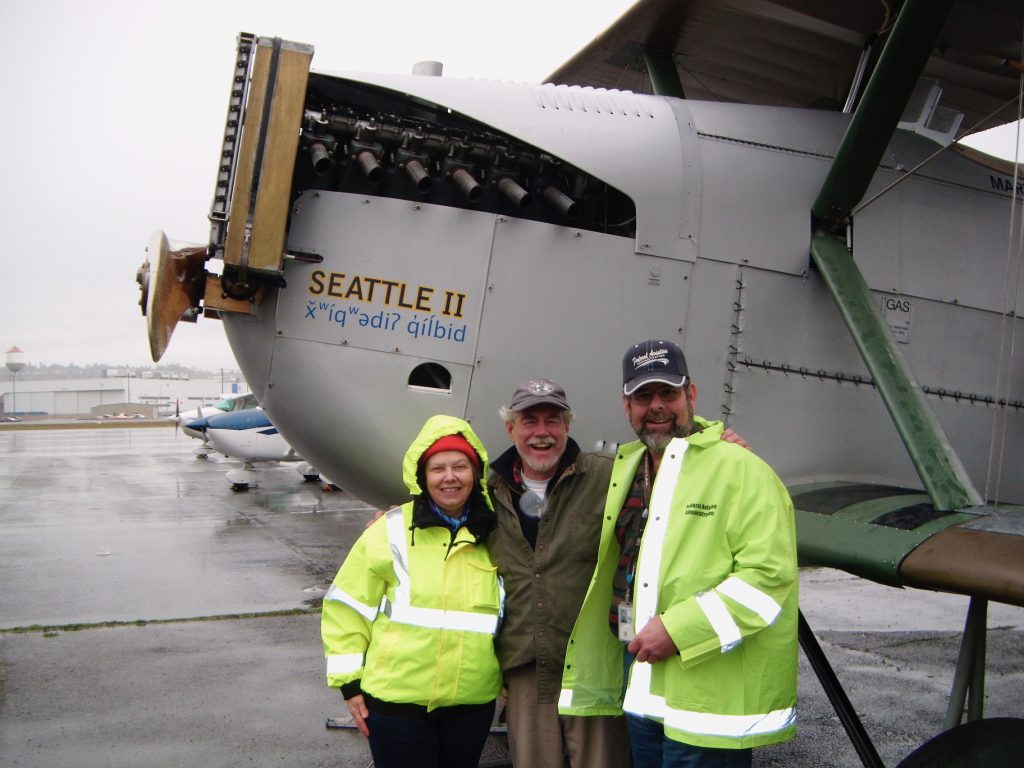
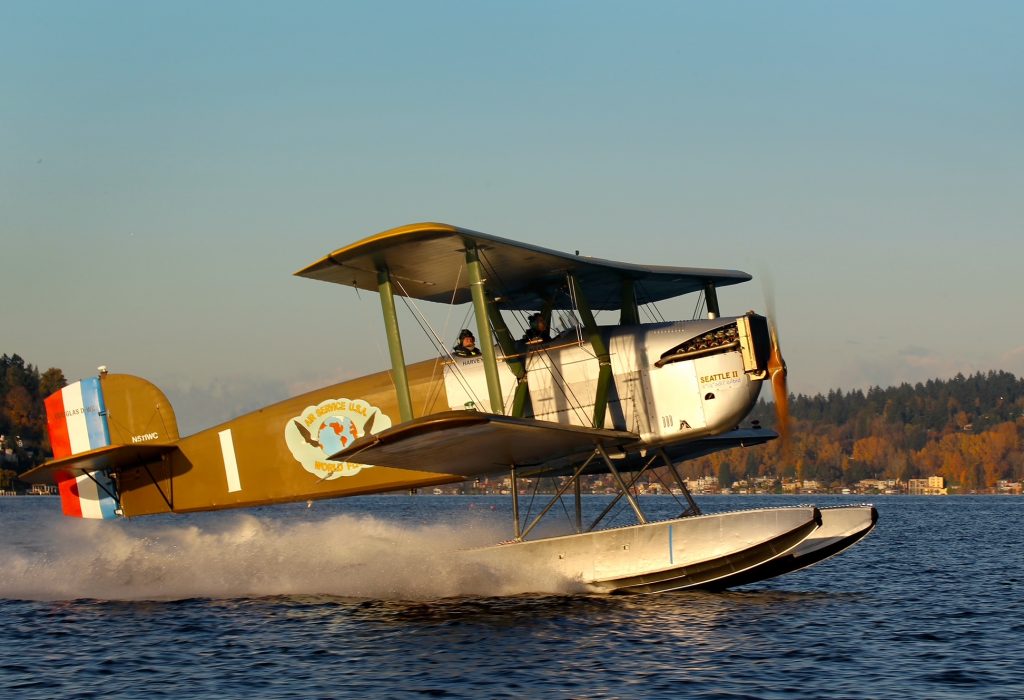
So there it was — the beginning of a 20-year project, six to seven days a week for me — building and flight-testing for FAA certification, a reproduction of the 1924 Douglas World Cruiser, the first aircraft to circumnavigate the globe. Our reproduction, “Seattle II,” grew and flew, gradually, in nine different locations, with the first “hop” at BFI (Boeing Field), flight-testing at Arlington, and Lake Washington seaplane trials at Renton.
RESEARCH
Locally, we have the Celebration Monument of The First World Flight at Seattle’s Sand Point and, with Peter Bowers’ photos I got my first window into the history and construction of the aircraft. My earliest “big stop” would be The Smithsonian, which I visited eight times in nine years. In time, my research net would include: Boeing and Douglas Archives, Air Force Museum, National Archives, Air Force Academy, Santa Monica Museum of Flying, Anchorage’s Alaska Aviation Museum, and the crash site near Port Moller, Aleutian Islands. I visited embassies in Japan and China, stopping in Shanghai at the Astor House Hotel, where the 1924 flyers stayed.
The history of the 1924 First World Flight: On 6 of April, four U.S. Air Service (Army) Douglas World Cruisers (DWC), named Seattle (command ship), Chicago, Boston, and New Orleans, departed Lake Washington, on floats, from Seattle’s Sand Point Field. The first audacious attempt to circle the globe became a successful journey that would take almost six months, over 27,000 miles, in open cockpit biplanes. At the conclusion (28 September 1924), two of the original aircraft returned, and the world had been conquered by air. It was, in fact, the second aviation milestone after the Wright Brothers.
BUILDING THE CRUISER
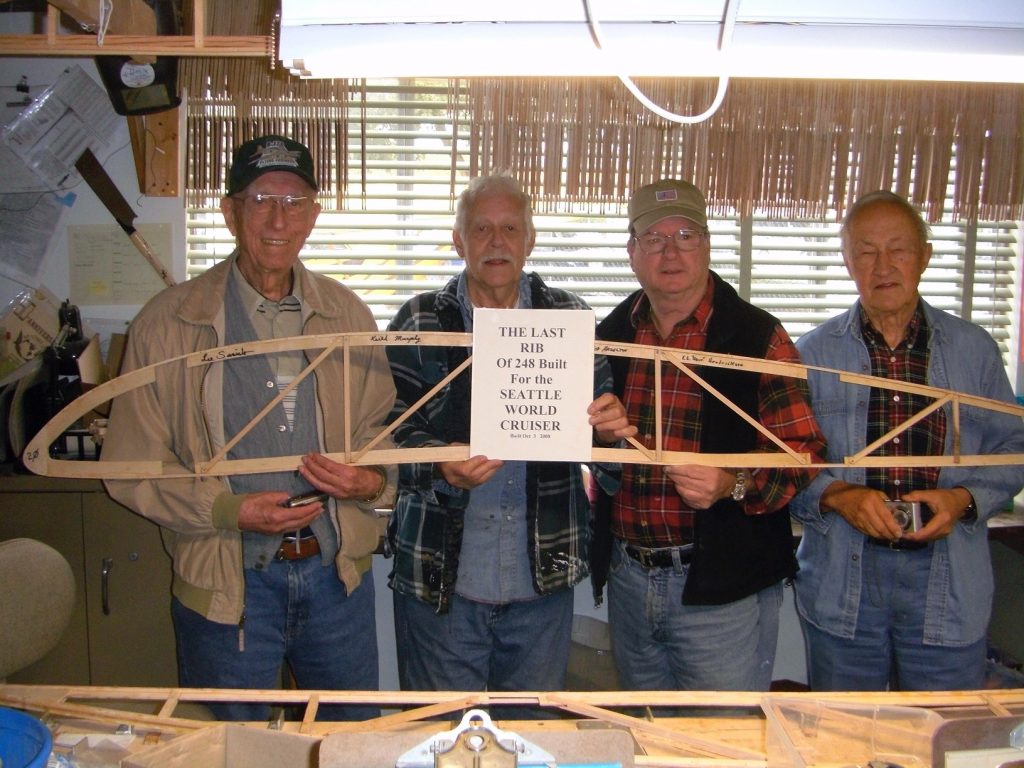
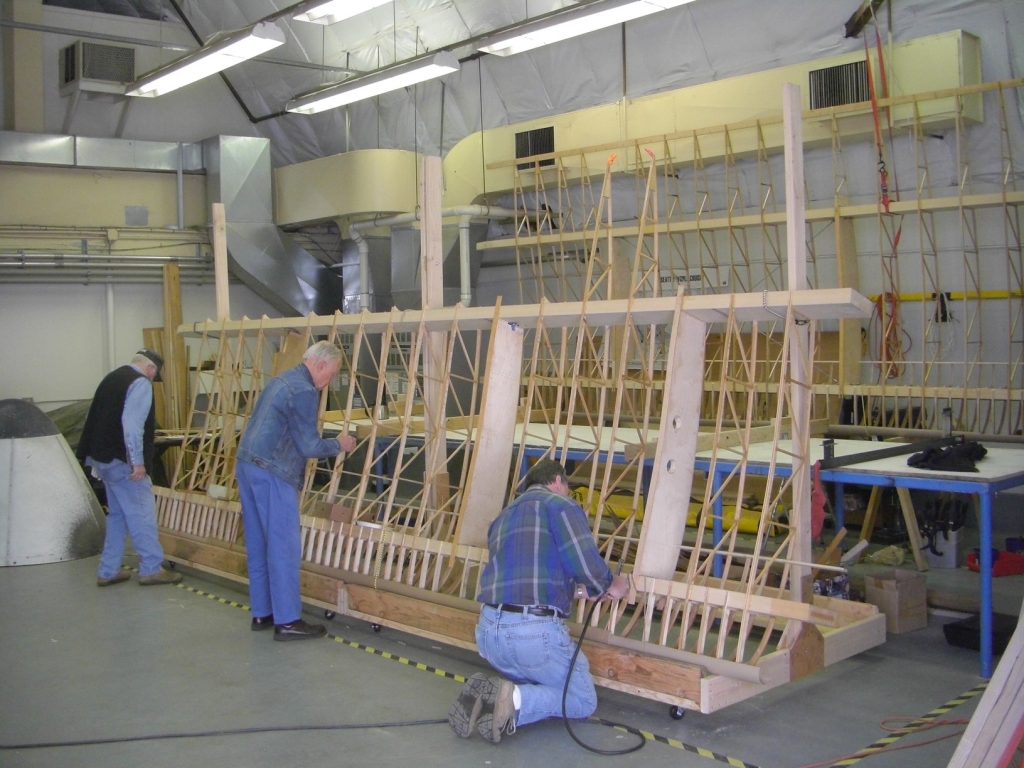
After buying Global Coffee — it had closed, and I needed a place to drink coffee with my neighbors and friends — I saw an opportunity to start building wing ribs, by knocking out a dividing wall. Everyone who stopped by — even Linda, our letter carrier (during her coffee break) — got into the act and helped build ribs.
As the project grew, it attracted many wonderful volunteers, moving around Renton Airport: to Aerodyne, a T-hangar, and the Maintenance Quonset Hut, where the fuselage, wings, tail section, landing gear, and wheels were all completed.
Our next major move was to Boeing Field’s historic Plant II. Scott Carson, then-president of Boeing Commercial (and a pilot, himself), provided the space for our expanding project in the old Seattle factory where the B-17s were built. There, I met Steve Kidd, a congenial character of infectious energy and enthusiasm. Steve, as owner of Cimtech, a Puget Sound-based business that supported CNC technologies, with training, software, and expertise, recreated many parts for the Museum of Flight’s B-29. Steve also generously laser-scanned the museum’s original 10-foot Liberty propeller, so we could build one — and a test club — for our Seattle World Cruiser project. He also reproduced exact copies of DWC aircraft wing position lights and lenses for The Smithsonian and us.
We completed and assembled all of the parts of the plane and even covered one wing with fabric before Boeing’s Plant II building was scheduled to be torn down. We then moved again, including two more stops on Boeing Field: Quad Seven and Clay Lacey, where avionics, final assembly, installation of the engine, two test hops, and Seattle II’s christening at The Museum of Flight, were accomplished.
FLIGHT TEST
The real flight tests though, started at Arlington Airport, exploring the aircraft’s flight envelope, which included stalls and one inadvertent dead-stick landing. The FAA required us to log 40 flight hours because the aircraft was designed before certification of airframes and engines. The process however, took much longer, as we strove to refine and improve the reliability of our 1918 Liberty V-12 engine, developed for WWI, and selected for 1924’s world flight.
We ended up — via local CNC machining and race car shops — replacing valve springs, valves, valve guides, pistons, rings, rod, main, and thrust bearings, carburetor floats with modern material, and exchanging the old generator for an alternator.
The sign-off of our Arlington FAA Flight Test Program coincided with our invitation to bring the Cruiser to Boeing Field, participating in Boeing’s 100th Anniversary Celebration. Diane flew with test pilot Carter Teeters to Boeing Field, making a couple of loops around the Space Needle along the way.
After Boeing’s celebration, we hopped the Cruiser over to Renton, beginning seaplane trials. Additional flight tests were required by FAA because floats represented a major configuration change. With our test pilot, James Young, the seaplane trials provided valuable floatplane performance data, to complete our FAA flight test program.
We’ve included a few photos here, of the hundreds that were taken over 20-plus years. Each tells a story, and each story is a facet of this remarkable journey — one which continues to evolve.
Sincerely, Bob and Diane Dempster
www.seattleworldcruiser.org
Every journey into this field is different – and I’m grateful for where mine has led.