By Jennifer Ferrero
The Mars Society has partnered with South Seattle College to establish a Mars research station to prepare students to plan a trip to Mars.
For at least two decades, suppliers in the commercial aerospace industry have understood that those trained directly in running machinery, understanding measurement and materials, and how things work on the shop floor will perform better than a white-collar worker with a four-year degree. Sure, the educated personnel will better understand sociology, communications, engineering, and management; but do they know how things are actually made?
The Mars Society is taking a bet that the future of space travel will be determined by the builders of the Industrial Revolution 4.0 — those who can look at a plan and understand how to make something with their hands, or with machines. So much so that they’ve signed a 10-year Memorandum of Understanding (MOU) with South Seattle College, one of Washington’s 34 Community and Technical Colleges with programs like:
- Skilled trades and technical training
- Culinary arts
- Health and medical
- Science, Technology, Engineering, and Math (STEM)
- Arts, design, and graphics

While this list isn’t exhaustive, programs in skilled trades and technical training may include automotive technology, aviation maintenance technology, or electric vehicle mechanics, which could translate to direct vehicle maintenance or electric propulsion on the Moon or Mars, for example.
The project instigators are essentially a trio of passionate players who are enamored with both establishing a Moon base and seeing humans reach Mars and live there. The group initially consists of The Mars Society’s Executive Director James Burk, South Seattle Program Director for a federal grant, Joydeep Hazra, and South Seattle Dean of Skilled Trades Ferdinand Orbino. College leadership, including President Dr. Monica Brown, has also brought passion and commitment to the project.
Brown said, “Our mix of skilled trades programming, proximity to aerospace industry hubs of Washington and available campus space for the Mars Analog Research Station make South Seattle College a good fit for connecting with The Mars Society.”
Developing a research station directly related to embedded empirical studies emerging from the college’s fundamental programs will take different forms. For example, if a culinary arts student, along with their normal course of study, determines they’d like to research growing and making food in zero gravity, they may decide to take on that project. An automotive technology student may wish to study engine propulsion for a Mars rover. The students and instructors will have the option to dream about how to wrap a Mars study around their program, according to Orbino.
The research station has yet to be officially named, but it will be located within an 87-acre portion of campus that includes hangar space and an aviation maintenance program. Burk said specific facilities are still under discussion. “Eventually, we will build a two-story habitat with some ancillary space-aesthetic buildings around it.” He said there will be classrooms and labs, office space, a coworking space for start-up companies, and mission support. Additionally, he envisions tours for K-12 students to become excited about the program.
For 20 years, The Mars Society has operated a similar space in Utah called the Mars Desert Research Station (MDRS). Per their website, “In the Red Desert of Utah, USA, is a Mars simulation laboratory for learning how to live and work on another planet. Its work has helped propel the pursuit of Mars and help make a human mission to Mars now within reach.” The MDRS offers a prototype habitat for living and working on Mars. Over 350 missions with over 2,000 crew members — four of whom have become astronauts — plus “geologists, astrobiologists, engineers, mechanics, physicians, human factors researchers, artists, and others” have studied at this location. At any given time, “There are six to seven crew members living for weeks to months in isolation in a Mars analog environment,” according to the website.
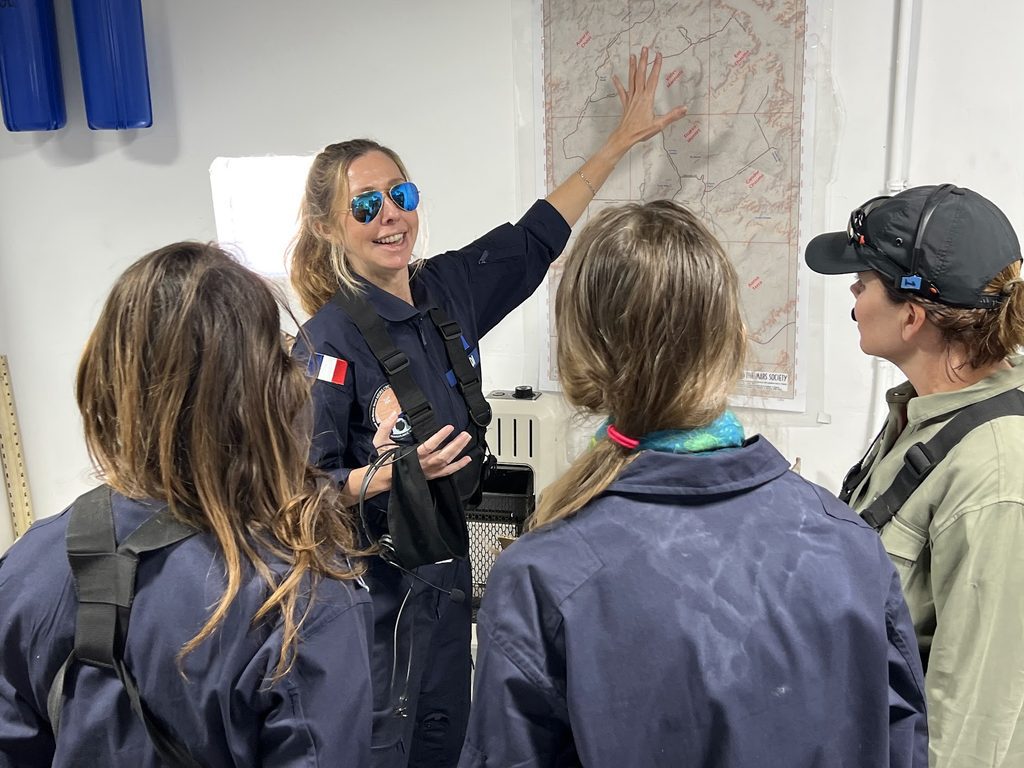
How South Seattle College Became the Next Mars Research Center
As many in the commercial aerospace supplier base know, numerous trade organizations and supplier partnerships share both ideas and contracts. This project was no different. James Burk, who built a career at Microsoft, has been involved with The Mars Society for its entire 30-year history and has served as its executive director for the past five years. The organization has 60 international volunteers and he has partnered with many other groups.
Through the The Mars Society, Burk became acquainted with Joydeep Hazra, who had been with Nokia and various startups. Hazra, with his extensive experience as technology advisor for the Tesla Owners Club of Washington (TOWA), decided to join South Seattle College as a grants manager to develop their electric vehicle program.
Mars studies and membership in The Mars Society were passions for both Burk and Hazra. Together, they decided to take their Mars-focused partnership to the next level – exploring the possibility of a liaison between the Mars Society’s goals of enabling the future of space travel, and developing education pathways for producing the skilled and technical workers essential to that vision. This affiliation brought them to the South Seattle College skilled trades Dean Orbino, whose passion is preparing the future generation for the workforce.
Orbino, a thought leader in workforce development, explained how educational and workforce silos keep big ideas from implementation. He wanted to blow past limitations to truly understand how his technical trade students could engage in this type of program. Orbino posits a holistic approach to careers, beginning with young students in a technician role. As they outgrow the role or its physical demands, they may continue their education to the next level. He said his concern is, “Our ability to serve people in meaningful ways —making sure we are in alignment and relevant with future workforce development needs and a student-centered perspective; how can I continue to build on those in the future?” Perhaps the integrated science/space study model will embed the student with more expansive thinking in their future career.
Before committing to South Seattle College, both Burk and Hazra shared that they had talked with other colleges, but none had the appropriate attributes of leadership buy-in or space. Hazra said the MOU was completed in less than a month, partially because of President Dr. Brown.
She said, “Identifying ways to embed space, science and Mars-related programming into our existing programs will be a collaborative process between The Mars Society, South Seattle College faculty and instructional leadership, and industry connections. We are excited to explore those opportunities as this vision develops.”
Burk looks to a future retirement on Mars and says that humans will be there within 10 years or less – with a moon research station set up within a couple of years. “I think we are very close to that happening, given the technological development by SpaceX and Blue Origin.” He shared that much of the technology has been or will be developed in the short-term to enable the first Mars mission. “Other countries are planning these missions as well. There’s a whole lot of activity.”
From the workforce development perspective regarding the timing of the program, Orbino said, “Part of my goal, and because I was born in Seattle and have a great affinity for Seattle, is to create a space for innovation specifically related to workforce development and the progression over the years. I hope it will continue to reinforce or solidify Washington as a leader in workforce innovation in the country and the world — the talent, skills, and ability — and I am honored and privileged to take a little part of that process.”
Hazra said about the new research center, as compared to the Utah facility, “We can start fresh.” He cited the 20-year age difference between the two facilities’ setups. He sees robotics integration, along with proof that with successful planning, they can demonstrate a low-risk environment for humans to go to Mars. They can do this by setting up a lunar habitat and then simulating the same environment. Additionally, Hazra envisions industry partnerships, such as one with Seattle City Light, to pose energy-related questions for students to solve.
Hazra said, “My greatest hope is to bring a lot of hope to the younger generation. The jobless rate is high post-college; we are also losing a lot of skilled labor. Within this puzzle, there is an extremely high need for people with technical skills.” He suggested students can pick up relevant, yet multidisciplinary skills.
Burk concluded that he’d like to see all college programs woven into the Mars research center, “touching all disciplines, with synergy.” He’d like to have a mission support team (made up of students and volunteers) at the station supporting other crews worldwide. Orbino said he’s looking for the best possible outcome for students with this integration. He also sees partnerships with other colleges as a way to leverage each other’s strengths with “the spirit of collaboration.”
Representing South Seattle College, Dr. Brown shared that the collaboration aligns with national priorities, such as NASA’s Artemis and Moon-to-Mars initiatives, and builds directly on our existing strengths in applied learning, faculty expertise, and industry partnerships. She concluded, “By integrating curriculum, research, and community engagement, we are creating meaningful pathways for our students into high-demand careers while elevating the college’s role in the Pacific Northwest’s innovation ecosystem. This initiative reflects our commitment to bold, future-oriented opportunities that expand access, inspire imagination, and ensure our students are prepared to lead in emerging industries.”
If future human Martians are reading this story, they might just feel optimistic that humans can bring a collaborative spirit to their planet, improving the future career outcomes and visions on both planets.